
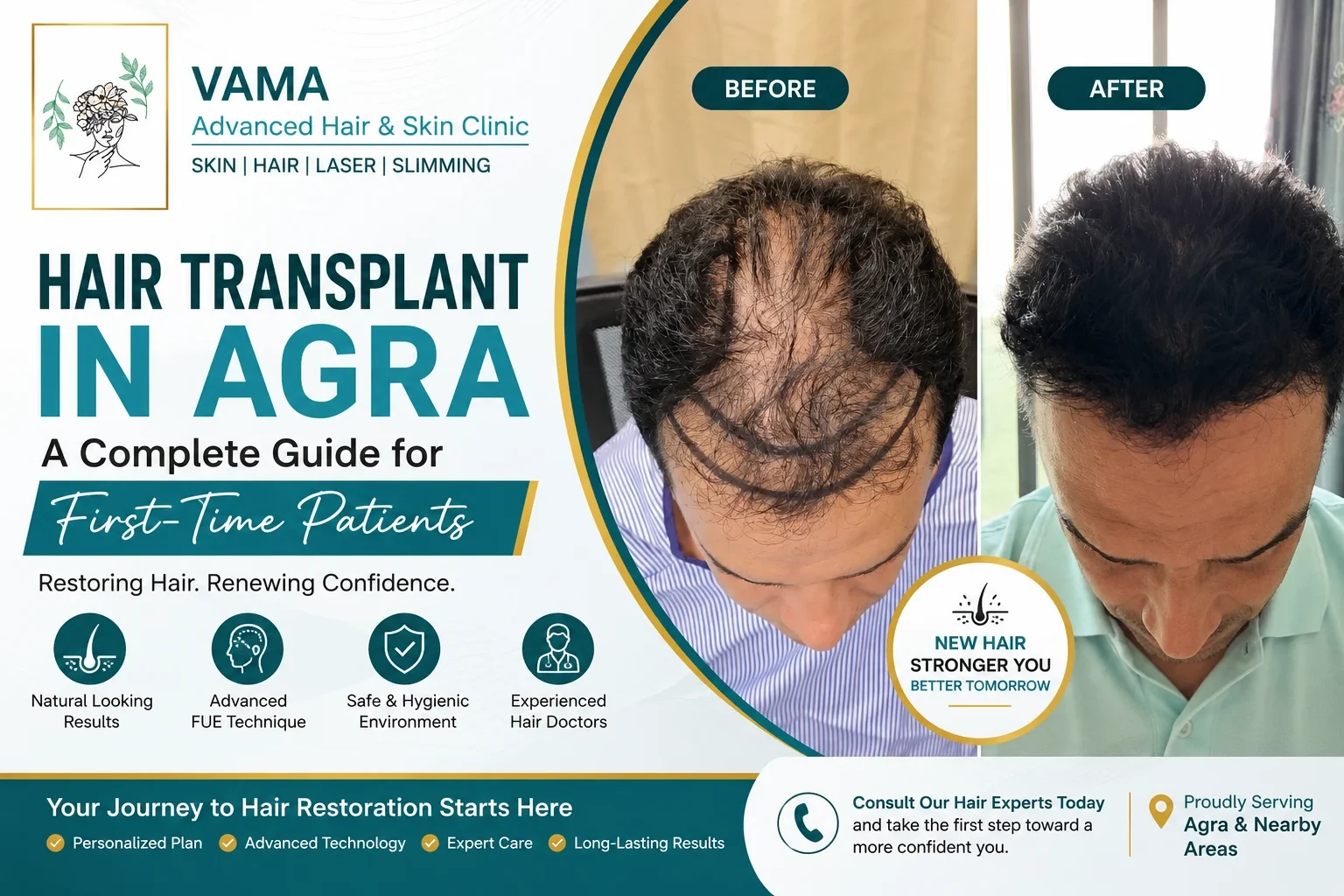
Hair loss can be a gradual process. Some people first notice a receding hairline, while others see thinning around the crown or a reduction in overall density. For some, a hair transplant in Agra is mainly a cosmetic concern; for others, it can affect confidence and everyday life.
If you are considering a hair transplant in Agra, it is useful to understand what the procedure involves, who may be suitable, how donor and recipient areas are assessed, and what kind of recovery to expect. A hair transplant is not a universal solution for every type of hair loss, so professional evaluation is an important part of the process.
This guide explains the basics for first-time patients in straightforward language.
Understanding Hair Loss and Hair Thinning
Hair loss can occur for many reasons. The pattern, speed and extent of hair loss can provide clues about its underlying cause.
One of the most common patterns is androgenetic alopecia, often referred to as male or female pattern hair loss. It can gradually affect the hairline, temples, crown or overall density, with genetics and hormonal factors often playing a role.
Other possible causes include:
- Nutritional deficiencies
- Certain medical conditions
- Hormonal changes
- Stress or illness
- Some medications
- Scalp disorders
- Traction from repeated tight hairstyles
- Autoimmune-related hair loss
Not every type of hair loss requires a transplant. In some cases, appropriate hair fall treatment may help manage the underlying problem or slow further progression. A proper diagnosis should therefore come before deciding on a procedure.
When Should You Consider a Hair Transplant?
A hair transplant may be considered when hair loss has resulted in areas of reduced or absent hair growth and sufficient healthy donor hair is available.
People commonly explore transplantation when they have:
- A receding hairline
- Male or female pattern hair loss
- Thinning around the crown
- Noticeable bald patches associated with suitable conditions
- Stable areas of hair loss
- Adequate donor hair for transplantation
Age alone does not determine suitability. The pattern and progression of hair loss, donor supply, scalp condition, general health and expectations are all important.
If hair loss is still progressing rapidly, a doctor may first recommend managing the condition before considering surgery. This can help with long-term planning and preservation of existing hair.
What Is a Hair Transplant?
A hair transplant is a surgical hair restoration procedure in which hair follicles are taken from a donor area and placed into areas affected by hair loss.
The donor area is generally the region of the scalp with healthy hair that can potentially be harvested for transplantation. The recipient area is where follicles are placed to restore or improve hair density.
The procedure requires careful planning because the available donor supply is limited. A good treatment plan should consider not only the hair loss visible today but also possible future changes.
Hairline Planning
Hairline design is particularly important. A hairline that looks appropriate for one person may not suit another because facial proportions, age, existing hair pattern and future hair loss can differ. The objective is generally to create a natural-looking transition rather than simply placing as many grafts as possible.
How Does FUE Hair Transplant Work?
FUE stands for Follicular Unit Extraction. It is a commonly used method of harvesting individual follicular units from the donor area. In simple terms, the process generally involves several stages:
- 1Consultation and planning — the doctor evaluates the pattern of hair loss, donor area, scalp, existing hair and desired outcome.
- 2Donor area preparation — the donor region is prepared for follicle extraction, based on the individual's available donor hair.
- 3Follicle extraction — individual follicular units are carefully extracted from the donor area using specialized instruments.
- 4Graft preparation — the extracted follicles are prepared for placement while maintaining their viability.
- 5Recipient area preparation — small openings are created according to the planned direction, angle and distribution of the hair.
- 6Graft placement — the prepared follicular units are placed into the recipient areas according to the treatment plan.
FUE can be useful because follicles are harvested individually rather than removing a long strip of scalp. However, it is still a surgical procedure and requires appropriate medical expertise.
Who May Be Suitable for Hair Transplantation?
Not everyone experiencing hair loss is an appropriate candidate for transplantation. A professional assessment may consider:
- Cause of hair loss
- Stability of hair loss
- Age and future hair-loss pattern
- Donor hair density
- Scalp health
- Hair characteristics
- Existing medical conditions
- Previous hair treatments or procedures
- Expectations regarding density and appearance
Someone with extensive hair loss and limited donor supply may have different options and expectations from someone with early-stage hairline recession. Treatment plans therefore vary from person to person.
Choosing a Hair Transplant Clinic in Agra
If you are researching a hair transplant clinic in Agra, avoid making a decision based only on advertisements, discounts or dramatic before-and-after photographs. Instead, look at the overall quality of the consultation and treatment planning.
Consider whether the clinic:
- Provides a proper assessment before recommending treatment
- Clearly explains the procedure
- Discusses donor and recipient areas
- Explains realistic outcomes
- Has appropriately qualified medical professionals
- Provides information about risks and recovery
- Offers suitable follow-up care
- Answers questions openly
For someone researching a hair transplant doctor in Agra, checking professional qualifications and experience with the relevant procedure can be more useful than relying on labels such as "best" or "top."
VAMA Solution is one of the clinics offering hair restoration services in Agra. However, patients should make their final treatment decision after an individual medical consultation.
Visit our Agra clinicQuestions to Ask Before Choosing a Clinic
Before proceeding with a hair transplant procedure, consider asking:
- What is causing my hair loss?
- Am I currently suitable for transplantation?
- How much donor hair do I have?
- Which transplant technique is being recommended?
- How will my hairline be planned?
- How many grafts may be appropriate for my case?
- What are the possible risks and side effects?
- What should I expect during recovery?
- When might I start seeing new growth?
- What happens if my existing hair continues to thin?
These questions can help you understand the treatment rather than simply choosing a procedure based on its name.
Factors That Can Affect Hair Transplant Results
Hair transplantation does not produce identical outcomes for every patient. Several factors can influence the final appearance.
Donor Hair Supply
The number, density and characteristics of available donor follicles affect how much coverage can realistically be achieved.
Existing Hair
The amount and condition of existing hair can influence the overall appearance of density after transplantation.
Hair Characteristics
Hair thickness, texture, color and natural curl can affect how dense the transplanted area appears.
Hair-Loss Progression
If existing, non-transplanted hair continues to thin, the overall appearance can change over time.
Surgical Technique
Careful extraction, graft handling, placement, angle, direction and distribution all contribute to the outcome.
Individual Healing
Patients heal differently — recovery and growth patterns can vary depending on individual factors.
Because of these variables, no responsible clinic should promise guaranteed, permanent or 100% results.
Hair Transplant Recovery and Aftercare
Recovery following an FUE procedure varies from person to person. Temporary redness, swelling, tenderness, crusting or sensitivity can occur in treated areas.
Your medical team may provide specific instructions regarding:
- Washing the scalp
- Sleeping position
- Physical activity
- Sun exposure
- Scalp protection
- Medications or prescribed products
- Follow-up appointments
Following aftercare instructions carefully can help support proper healing.
It is also important to understand that transplanted hair does not immediately appear as the final result. Hair growth occurs gradually, and the timeline varies between individuals.
Frequently Asked Questions
No. Suitability depends on the cause and progression of hair loss, donor hair availability, scalp condition, general health and individual expectations. A medical assessment is necessary.
Conclusion
A hair transplant in Agra can be an option for selected people experiencing pattern hair loss or other suitable forms of permanent hair loss. However, deciding to undergo transplantation should begin with understanding the cause of hair loss and assessing whether the available donor hair can support the desired restoration.
FUE is one commonly used approach, involving the individual extraction and placement of follicular units. Successful planning involves more than the extraction technique — it also requires careful consideration of the donor area, recipient area, hairline, existing hair, future hair loss and realistic expectations.
Book a free consultationHave a question about this?
Talk to one of our specialists directly — no obligation.
Book a Consultation