
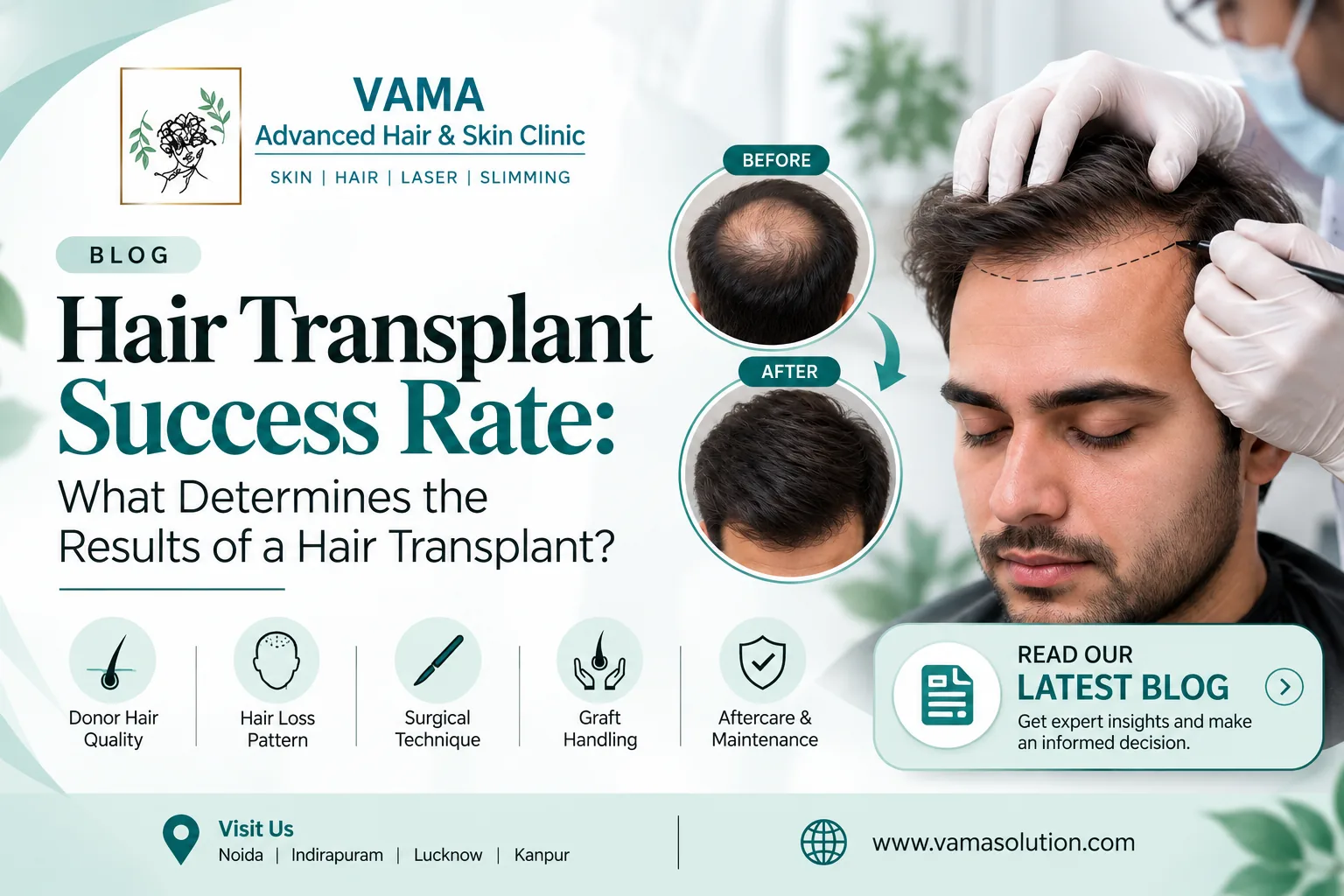
A hair transplant can be an effective option for people experiencing permanent hair loss, but one of the most common questions patients ask is: What is the success rate of a hair transplant?
The answer is more complex than a single percentage.
Hair transplant results depend on several factors, including the patient's hair-loss pattern, donor hair quality, number and quality of available grafts, treatment planning, surgical technique, graft handling, recipient-site design and aftercare.
A well-planned procedure aims to redistribute healthy donor follicles into areas affected by hair loss while creating a natural-looking hairline and appropriate density. However, every patient has different characteristics, so results cannot be guaranteed to be identical.
If you are considering hair transplant in Noida, understanding these factors can help you make a more informed decision before treatment.
What Is a Hair Transplant?
A hair transplant is a surgical hair-restoration procedure in which hair follicles are taken from a donor area and placed into areas affected by hair loss.
The donor area is commonly located at the back or sides of the scalp because these hairs may have greater resistance to the effects of androgenetic hair loss.
Three commonly discussed hair-transplant techniques are:
- FUE (Follicular Unit Excision)
- FUT (Follicular Unit Transplantation)
- DHI (Direct Hair Implantation)
FUE involves removing individual follicular units from the donor area before preparing and implanting them into the recipient area.
FUE is a surgical procedure rather than simply a cosmetic or machine-based treatment. The International Society of Hair Restoration Surgery (ISHRS) states that procedures involving incisions for harvesting or preparing the scalp for graft placement should be performed by appropriately trained and licensed physicians.
What Is the Success Rate of a Hair Transplant?
There is no single success percentage that can accurately predict the outcome for every patient.
Hair transplantation involves living follicles, and the final cosmetic result depends on multiple variables. A patient's donor characteristics, the extent of hair loss, graft quality, surgical planning and postoperative care can all influence the outcome.
Rather than focusing only on a quoted "success rate," patients should ask:
- How is my donor area?
- How advanced is my hair loss?
- How many grafts may be required?
- Is my donor supply sufficient?
- Who will perform the surgical steps?
- How will the hairline be designed?
- How will the grafts be handled?
- What should I realistically expect after surgery?
- What happens if my existing hair continues to thin?
These questions provide a more useful understanding of expected results than a single percentage.
What Factors Affect Hair Transplant Results?
1. Donor Hair Quality
The donor area is one of the most important considerations in hair restoration.
A patient with adequate donor density and suitable hair characteristics may have more options for restoration than someone with limited donor reserves.
Donor hair is a finite resource. Once follicles are removed from the donor area, those specific follicles are not available for future procedures. ISHRS therefore emphasizes careful and judicious use of donor hair, particularly when planning for potential future hair loss.
2. Extent and Pattern of Hair Loss
The stage and pattern of hair loss can affect treatment planning.
A patient with a relatively limited area of thinning may require a different treatment strategy from someone with extensive hair loss involving the frontal scalp, mid-scalp and crown.
A good treatment plan should consider not only the areas that are currently thinning but also the possibility of future progression.
3. Hairline Design
A natural-looking hair transplant is not simply about adding as many grafts as possible.
Hairline position, shape, angle and transition from finer to thicker hairs all contribute to the overall appearance.
The ISHRS notes that naturalness depends on factors such as hairline design, recipient-site angle and distribution, as well as appropriate graft placement.
4. Graft Handling
After follicles are harvested, they must be handled and maintained appropriately before implantation.
Grafts can be vulnerable to damage from factors such as excessive handling, dehydration and inappropriate storage.
Surgical skill is therefore only one part of the process. Proper graft management throughout the procedure is also important for protecting follicular tissue.
5. Surgical Technique
FUE has become widely used in modern hair restoration.
However, FUE itself does not automatically guarantee a particular result. The technique is a method of harvesting donor follicles, while the overall cosmetic outcome also depends on diagnosis, planning, harvesting, recipient-site creation and implantation.
ISHRS also cautions against marketing language such as "scar less hair transplant." FUE generally avoids the linear scar associated with strip harvesting, but small circular scars can occur because follicles are removed from the skin.
6. Surgeon Training and Experience
Hair transplantation requires medical and surgical knowledge.
Patients should understand who will diagnose their hair-loss condition, design the treatment and perform the surgical components of the procedure.
ISHRS recommends that patients ask about a physician's medical education, licensing, additional training and professional qualifications before choosing a hair-restoration surgeon.
7. Postoperative Care
The period after surgery is also important.
Patients are generally given specific instructions regarding scalp care, washing, physical activity, medications and follow-up.
Following the treating medical team's instructions can help support proper recovery.
Patients should also understand that transplanted hair does not immediately produce the final cosmetic result. Hair growth takes time, and the appearance can change considerably during the recovery and growth phases.
Does FUE Hair Transplant Give Permanent Results?
Hair transplantation is intended to provide long-term restoration using donor follicles selected for their characteristics.
However, "permanent" should not be interpreted as meaning that every existing hair on the scalp will remain unchanged forever.
Transplanted follicles can have long-term growth potential, while non-transplanted, naturally occurring hair may continue to thin depending on the underlying cause of hair loss.
This is why diagnosis and long-term planning are important before undergoing surgery.
What Happens After a Hair Transplant?
Hair restoration is a gradual process.
Immediately after surgery, the scalp may show temporary redness, swelling or small crusts around the treated areas. Some transplanted hairs may also shed during the early period.
This does not necessarily mean the transplant has failed.
New hair growth takes time, and the final appearance develops gradually.
Your doctor should explain the expected recovery and growth timeline based on your individual procedure.
Can PRP Improve Hair Transplant Results?
PRP Hair Treatment Sector 70 Noida may be considered as part of a broader hair-management plan for selected patients.
PRP uses components derived from the patient's own blood and is used in some hair-loss treatment settings.
However, PRP is not a replacement for hair transplantation when a patient has significant permanent hair loss requiring surgical restoration.
Its suitability should be assessed individually by a qualified healthcare professional.
How to Choose a Hair Transplant Clinic in Noida?
Choosing a clinic should involve more than comparing package prices.
If you are searching for a Hair Transplant Clinic in Sector 70 Noida, consider the following:
Check the Doctor's Qualifications
Ask about the doctor's medical qualifications, hair-restoration training and experience.
Understand Who Performs the Surgery
Clarify which medical professional will perform the surgical components of your procedure.
Ask for a Proper Hair-Loss Diagnosis
Hair loss can have different causes. A proper diagnosis is important before deciding whether transplantation is appropriate.
Evaluate the Donor Area
A consultation should include assessment of donor density, hair caliber and available donor reserves.
Discuss Future Hair Loss
A good plan should consider possible future progression rather than focusing only on the current bald or thinning area.
Ask About Follow-Up
Understand what postoperative monitoring and support are included after the procedure.
Hair Transplant Treatment in Sector 70 Noida
Patients looking for a Hair Transplant Doctor in Sector 70 Noida should consider having a professional consultation before deciding on surgery.
A consultation can help assess the pattern and extent of hair loss, examine the donor area and discuss whether transplantation is an appropriate option.
For patients considering FUE Hair Transplant in Sector 70 Noida, understanding the procedure, donor limitations, recovery and expected results is particularly important.
A professional Hair Restoration Clinic Sector 70 Noida should focus on appropriate patient selection and individualized treatment planning rather than promising identical outcomes for every patient.
Similarly, patients searching for Hair Loss Treatment Sector 70 Noida may benefit from diagnosis before choosing a particular procedure. Hair transplantation is not appropriate for every type or stage of hair loss.
Why Choose VAMA Clinics for Hair Transplant?
VAMA Clinics provides hair-restoration services designed around individual patient requirements.
The treatment approach can begin with evaluation of the patient's hair-loss pattern, donor area and restoration goals before discussing appropriate options.
For patients considering hair restoration, the consultation can help explain:
- Whether transplantation may be suitable
- The condition of the donor area
- The likely treatment approach
- Hairline and density considerations
- Expected recovery
- Long-term hair-loss management
- Post-treatment care
The objective is to create a treatment plan based on the patient's individual characteristics rather than applying the same approach to everyone.
8 Questions to Ask Before Your Hair Transplant
Before booking your procedure, ask your clinic:
- 1What is causing my hair loss?
- 2Am I a suitable candidate for transplantation?
- 3How strong is my donor area?
- 4How many grafts might I need?
- 5Who will perform the surgical steps?
- 6How will my hairline be designed?
- 7What should I expect during recovery?
- 8How will future hair loss be managed?
Getting clear answers can help you understand the procedure and make an informed decision.
Frequently Asked Questions
There is no single success rate that applies to every patient. Outcomes depend on donor quality, hair-loss pattern, surgical planning, graft handling, implantation and postoperative care.
Conclusion
The success of a hair transplant should not be judged by a single percentage.
A successful hair-restoration plan involves appropriate patient selection, accurate diagnosis, donor-area assessment, realistic planning, careful graft handling, appropriate surgical technique and proper postoperative care.
If you are considering hair transplant near Sector 70 Noida, take time to understand your options and discuss your expectations with a qualified medical professional.
VAMA Clinics can provide a professional consultation to help you understand your hair-loss condition, treatment options and the factors that may influence your expected outcome.
Medical Disclaimer
Treatment recommendations depend on individual assessment, and results can vary from person to person. This article is for general informational purposes only and does not constitute medical advice.
Book a free consultationHave a question about this?
Talk to one of our specialists directly — no obligation.
Book a Consultation