
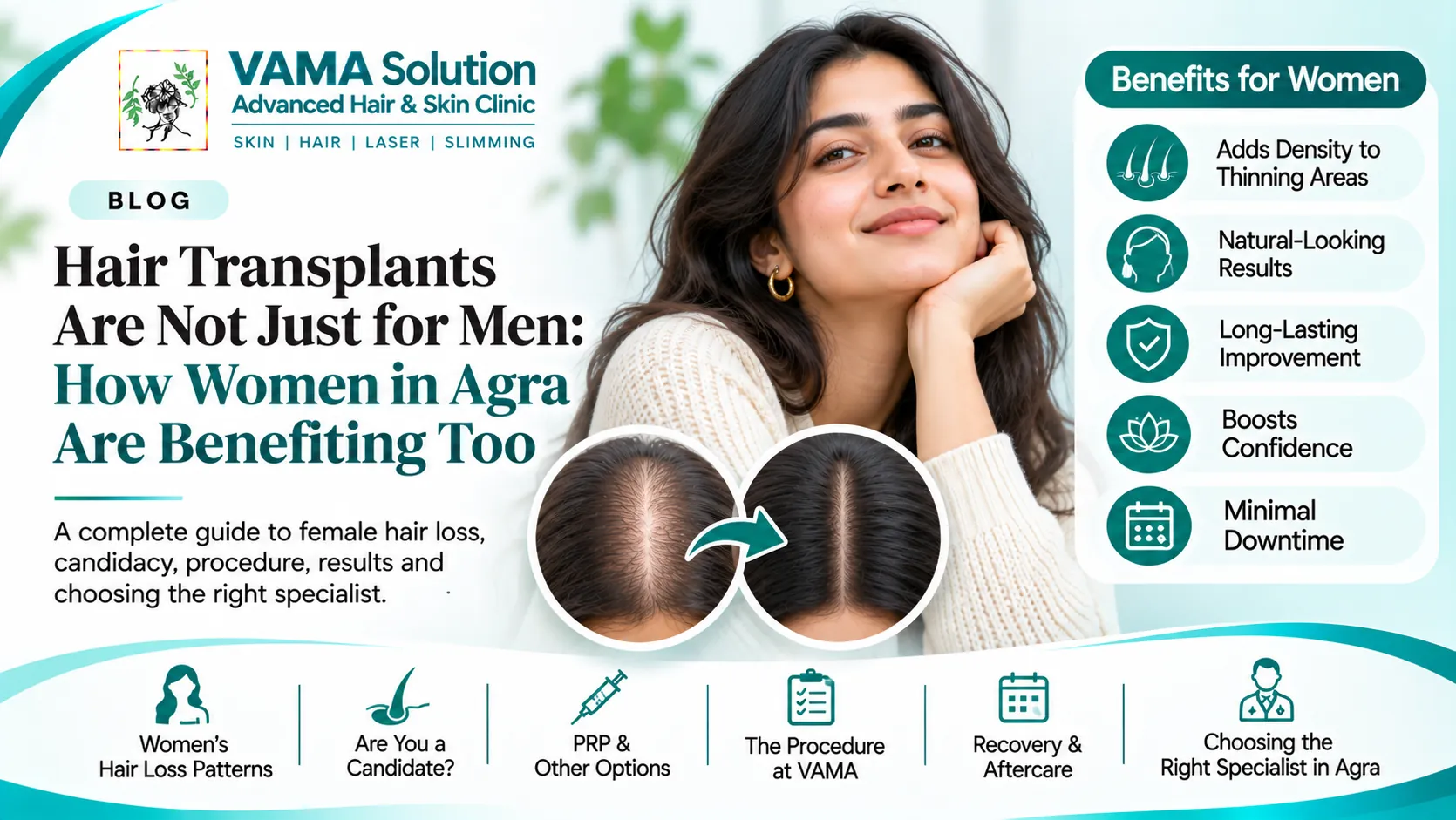
When people think of a hair transplant, they usually picture a man with a receding hairline. But hair loss does not discriminate. Many women notice a wider parting, thinner ponytail or visible scalp under bright light, and the emotional toll can be just as heavy.
The encouraging news is that hair transplantation can help women too, in the right cases. If you are researching options at a Hair Restoration Clinic in Agra, this guide explains how female hair loss differs, who may be a candidate, what the procedure involves and what to expect afterwards.
What Is a Hair Transplant?
A hair transplant is a minimally invasive surgical procedure that moves healthy hair follicles from a donor area, usually the back or sides of the scalp, to thinning or bald areas. Because the transplanted hair is your own, it grows like normal hair once it settles in.
At VAMA Solution, we primarily use Follicular Unit Extraction, or FUE. Follicles are extracted individually and implanted with attention to angle, direction and density, so the result blends with your existing hair.
Is a Hair Transplant Only for Men?
No. Men make up a larger share of patients, but women can have transplants too, and the technique works on the same principle. Women may also choose eyebrow restoration or scar correction on the scalp. The key difference is that women's hair loss often follows a different pattern, so a more careful assessment is needed before deciding.
How Does Hair Loss Differ Between Men and Women?
Men typically lose hair in a recognizable pattern: a receding hairline, thinning temples or a bald crown. Women more often experience diffuse thinning, where hair becomes less dense across the top of the scalp while the frontal hairline stays in place. A widening parting is a common early sign.
This matters because a transplant works best when there is a stable, healthy donor area. In diffuse thinning, the donor hair may also be affected, so not every woman is a suitable candidate. That is why diagnosis comes first.
Why Do Women Lose Hair?
Common causes include:
- Hormonal changes: pregnancy and childbirth, menopause, PCOS and thyroid problems
- Genetics: female pattern hair loss runs in families
- Nutrition: low iron, vitamin D or protein
- Stress and illness: physical or emotional stress can trigger shedding
- Medicines and treatments: some medicines can cause hair fall
- Styling habits: tight hairstyles, heat and harsh chemicals can cause traction and damage
- Scalp conditions: dandruff, infections and inflammation
Many of these are treatable without surgery, which is why a transplant should never be the first step before the cause is identified.
Who Is a Suitable Candidate?
A hair transplant may be considered for women who:
- Have permanent hair loss in a specific area, such as a high or receding hairline, a thinning parting or a scarred patch
- Have enough healthy donor hair
- Have a stable pattern of hair loss with the underlying cause addressed
- Are in good general health
- Have realistic expectations about density and timing
Women with active, unexplained shedding, untreated thyroid or hormonal problems, or very limited donor hair may be advised to treat the cause first, or to consider non-surgical options.
What About Non-Surgical Options?
Not every woman needs surgery. For early thinning, treatments that support the follicles you already have can be very effective. Many patients first explore Plasma Therapy for Hair in Agra, commonly known as PRP, where a concentrate from your own blood is injected into the scalp to support weakened follicles.
It works on active follicles, so it is not a replacement for a transplant in areas that have lost hair completely. Medical treatment, nutritional correction and scalp care may also be part of the plan. A good clinic will tell you honestly which route fits your stage of hair loss.
How Does the Procedure Work at VAMA?
Our process is simple and personalised:
- 1Initial consultation: a detailed scalp examination to assess hair density, donor availability and likely future hair loss, along with your medical history.
- 2Donor hair extraction: individual follicles are carefully extracted using specialised instruments that minimize discomfort and scarring. Ask whether the donor area needs trimming, since this matters for many women.
- 3Hairline design: a customized hairline is planned to suit your face and keep a soft, natural look.
- 4Graft implantation: follicles are placed into the thinning area at the right angle, direction and density.
- 5Recovery and follow-up: most patients return to routine within a few days, with follow-up visits to track healing.
The procedure is performed under local anaesthesia, so it is comfortable, and mild soreness afterwards is normal.
The Top Benefits of a Hair Transplant for Women
Fuller-Looking Hair Where You Need It
A transplant adds density to thin areas, such as a widening parting or a high hairline, using your own follicles.
A Natural Finish
With careful hairline design and graft placement, the new hair blends in with the rest of your hair.
Long-Lasting Results
Transplanted follicles are generally long-lasting, though your existing non-transplanted hair can still change with time, so your doctor will plan for that.
Improved Confidence
Many women say they feel more comfortable with their hair, in photos and in social settings after treatment. Results vary from person to person.
Low Downtime
FUE is an outpatient procedure with no stitches, and most women return to routine activities within a few days.
How Do You Choose the Right Specialist?
Skill and honesty matter more than any advertisement. When you compare Hair Transplant Doctors in Agra, ask whether they treat female hair loss regularly, how they assess donor stability and whether they will recommend non-surgical options when appropriate.
Look for a Top Hair Transplant Surgeon in Agra who explains your diagnosis in plain language, shows results on patients similar to you and gives a clear written plan.
Good questions to ask any clinic:
- Who will perform each step of my procedure?
- How will you diagnose the cause of my hair loss?
- Am I a suitable candidate, and what are the alternatives?
- How many grafts will I need, and what does the quote include?
- What does aftercare look like, and who do I contact afterwards?
Aftercare Tips
Proper aftercare protects your result:
- Avoid touching the transplanted area in the first few days
- Sleep with your head slightly elevated
- Avoid strenuous exercise for about two weeks, or as your doctor advises
- Use only prescribed shampoos and medicines
- Protect your scalp from direct sunlight
- Attend all follow-up visits
Temporary shedding of the transplanted hair is normal. New growth usually begins within 3 to 4 months, with fuller results developing over 8 to 12 months.
Frequently Asked Questions
Yes, in suitable cases. A specialist must first confirm the cause of hair loss and the stability of donor hair.
Final Thoughts
Hair transplants are not just for men. For women with the right pattern of hair loss, a well-planned procedure can restore density and confidence. But the key is a proper diagnosis, honest advice and realistic expectations.
If you want guidance from an experienced team, book a consultation with VAMA Solution. Whether you are searching for the Best Hair Transplant Doctor in Agra or comparing options, we will examine your scalp, explain your choices and recommend what suits you, not what is easiest to sell. You can also explore the Best Hair Transplant Surgeon in Agra options at VAMA, and take the first step towards fuller, healthier-looking hair.
Have a question about this?
Talk to one of our specialists directly — no obligation.
Book a Consultation