
Ask a woman when she first noticed her hair thinning and she rarely names a date. It crept up. A ponytail that needed an extra twist of the hair tie. A parting that looked a little wider in the car mirror. A brush that seemed fuller than it used to be. Because the change is gradual and often diffuse, many women spend a year or two telling themselves it is nothing.
Sometimes it is nothing. Often it is a pattern, and patterns can be read. This guide walks through the shapes female hair loss commonly takes, what usually sits behind each one, and the point at which it makes sense to stop guessing and see someone who can look at your scalp properly. If you are in Uttar Pradesh and thinking about hair treatment in Lucknow, this is a good place to start.
First, How Is It Different from Men's Hair Loss?
In men, loss typically has edges: a hairline that retreats, a crown that opens, a clear zone of baldness. In women, the hair usually thins across the top of the scalp while the frontal hairline stays largely where it was. Total baldness is uncommon.
That is why women's thinning is so easy to miss and so easy to dismiss. There is no dramatic patch to point to, just a gradual loss of volume.
The Common Patterns
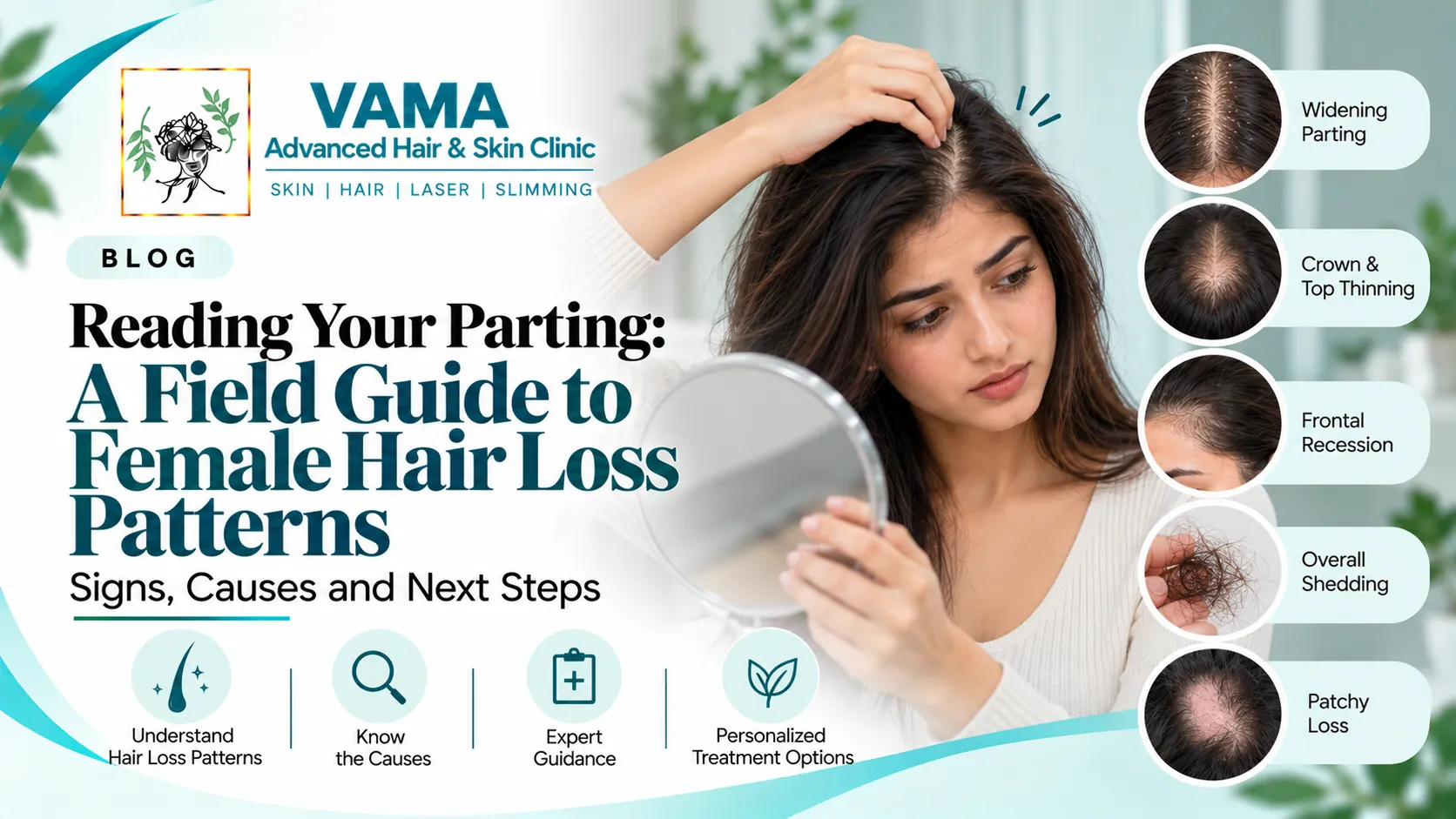
Pattern 1: The Widening Parting
The most recognizable sign. The central parting slowly broadens, and the scalp becomes more visible along it, especially under bright light. Photographs of the top of your head taken a year apart can make the change obvious.
Pattern 2: Crown and Top Thinning
Hair across the top of the scalp becomes finer and sparser, often described as a "Christmas tree" shape when viewed from above, with a narrow parting at the top and a broader area of thinning further down. Doctors grade this kind of pattern with tools such as the Ludwig scale, from mild to advanced.
Pattern 3: Frontal Recession
Less common, but real. Some women see their hairline move back, particularly at the temples. This can come from hormonal changes, from a genetic pattern, or from years of tight styling that pull on the hairline.
Pattern 4: Overall Shedding
Instead of a pattern in one area, you simply lose more hair than usual all over, a few months after a trigger such as illness, childbirth, a crash diet or a period of intense stress. This type, called telogen effluvium, often recovers once the trigger passes.
Pattern 5: Patchy Loss
Round, well-defined bald patches are a different story. They can point to an autoimmune cause such as alopecia areata, or to a scalp condition, and they deserve medical attention rather than waiting.
What Usually Sits Behind the Pattern
- Genetics: Female pattern hair loss runs in families, and it can come from either side. It tends to progress slowly over years.
- Hormones: Thyroid problems, PCOS, pregnancy, the months after delivery and menopause all influence the hair cycle.
- Nutrition: Low iron, vitamin D, zinc or protein, and very restrictive dieting, can push hair into a shedding phase.
- Medical conditions and medicines: Anemia, autoimmune disease, some long-term medications and major illness all appear on the list.
- Styling habits: Tight buns and braids, frequent heat, bleaching and strong chemical treatments can weaken hair and, over years, damage the hairline.
- Stress and sleep: Not usually the sole cause, but a common trigger or aggravator.
Many women have more than one of these at the same time, which is exactly why a quick guess rarely works.
A Five-Minute Self-Check
None of this replaces an examination, but it can help you decide whether to book one.
- 1Look at your parting in the same light and the same position every month, and take a photo.
- 2Compare old photos of your ponytail or hair density from a year or two ago.
- 3Notice the brush and the drain. Losing around a hundred strands a day is normal. Sudden, clump-like shedding is not.
- 4Look for patches or areas where the scalp is shiny, red, flaky or sore.
- 5Check other symptoms such as fatigue, irregular periods, weight changes or feeling unusually cold, which may point to a thyroid or hormonal cause.
If more than one of these rings true, or the change has continued for a few months, it is time to ask a professional.
What Diagnosis Actually Involves
A proper evaluation is less mysterious than people expect. It usually covers your medical and family history, your diet and medicines, a close look at your scalp and hair, and often a set of blood tests to check things like thyroid function, iron and vitamin levels. In rare cases a small scalp sample may be taken.
The aim is to separate temporary causes from permanent ones, because they are managed very differently. Shedding after a fever may simply need time and good nutrition. Genetic thinning needs a long-term plan.
What Can Be Done
Treatment depends entirely on the cause. Depending on your diagnosis, a doctor may suggest correcting a deficiency or a hormonal problem, adjusting hair care habits, prescribing a topical or oral medicine that is appropriate for you, or using supportive therapies such as platelet-rich plasma. These options work best when started early and followed consistently, and they often take months to show a difference.
And When Is Surgery in the Picture?
A hair transplant is not the first answer for most women, but it can help a carefully selected few. The best candidates tend to have a stable pattern, a healthy donor area at the back of the scalp and a clear, treatable zone, such as a thinning parting or a receding hairline.
If surgery does come up, the person performing it matters enormously. A skilled hair transplant surgeon in Lucknow will plan around diffuse thinning, protect your donor supply and tell you honestly if it is not the right moment.
Why the Word "Plantation" Keeps Appearing
If you have searched online, you may have seen the term "hair plantation," which people use informally to mean hair transplantation. When you look into hair plantation in Lucknow, ignore the label and ask about the substance: who diagnoses you, what technique is used, how the plan suits diffuse thinning, and what follow-up you receive.
Choosing Where to Go
For women especially, the quality of the consultation says a lot. Good signs include being examined before being quoted, hearing about causes that have nothing to do with surgery, being told clearly who will plan and perform each step, and being given written aftercare and follow-up.
Warning signs include a quote over chat without anyone looking at your scalp, guarantees of density, or pressure to pay quickly. Take a look around when you visit a hair transplant centre in Lucknow, too: the space should be clean and organised, and the team should be willing to answer difficult questions without hurrying you.
When you compare options for the best hair transplant clinic Lucknow can offer, "best" is personal. It is the clinic that diagnoses carefully, explains openly and stays with you through recovery, not the one with the loudest advertising.
Protecting Your Hair for the Long Term
Whatever route you take, a few habits help.
Handle wet hair gently, since it is more fragile. Go easy on tight styles and on heat, and give chemical treatments real gaps between sessions. Eat enough protein, iron and other nutrients, and treat sleep as part of hair care. Keep a regular check on your parting with photos, and see a doctor sooner rather than later if it changes.
Most importantly, be patient. Hair grows slowly, and any treatment, medical or surgical, needs months before the result becomes clear. Judging it at week six only creates worry.
When to Stop Waiting
Book a consultation if your parting keeps widening, if shedding has lasted more than a few months, if you notice patches, or if the thinning comes with fatigue, irregular periods or other changes in your health. Early diagnosis gives you more options and usually better results.
At VAMA, our approach is a personal assessment and a realistic plan, with the understanding that results vary from person to person. Whether you need a nutritional fix, a medical plan or simply reassurance, the first step is the same: a proper look at your scalp.
If you are weighing your choices, a consultation about hair treatment in Lucknow is a calm, pressure-free way to find out what is actually going on.
Have a question about this?
Talk to one of our specialists directly — no obligation.
Book a Consultation