
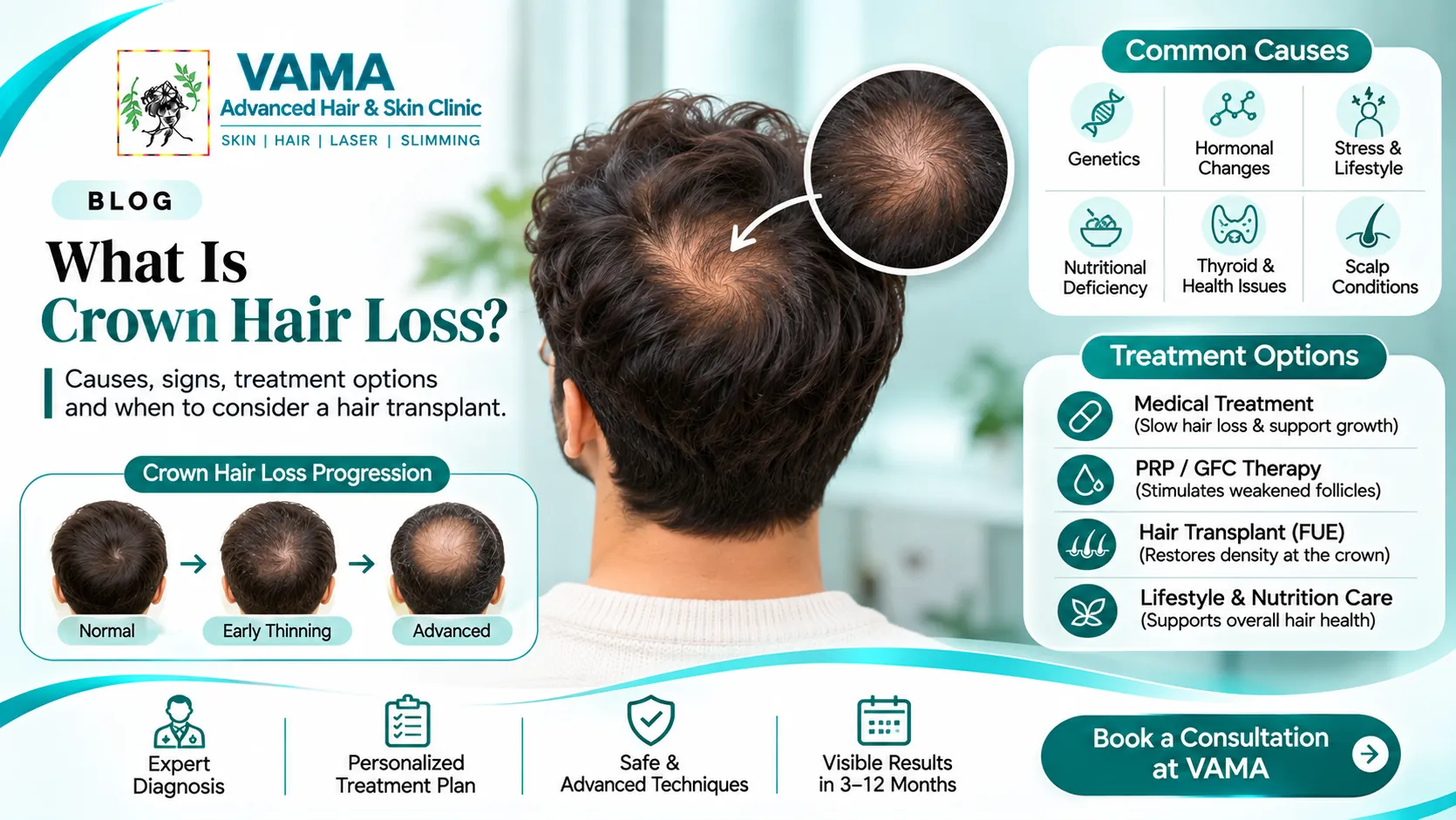
You catch a glimpse of the back of your head in a mirror or a photo and notice a thinner patch you never saw before. Crown hair loss, also called vertex thinning, often starts quietly and is spotted by others before the person themselves.
The good news is that early action can make a real difference, and there are more treatment options today than ever before. If you are looking for a trusted hair clinic Lucknow to understand what is happening on your scalp, this guide explains what crown hair loss is, why it happens, how to recognize it and what you can do about it.
What Is Crown Hair Loss?
Crown hair loss is thinning or balding at the vertex, the top-back area of the scalp where the hair grows in a swirl pattern. It often begins as a small, round or oval patch of reduced density that slowly widens over time. In some people it stays limited, while in others it joins up with thinning at the front and sides.
It affects both men and women, but it looks different in each. Men more often develop a distinct, enlarging thin spot at the back of the head. Women tend to experience a more diffuse thinning across the top, with a widening parting, rather than a clear bald patch.
Symptoms: How Do You Spot Crown Thinning?
Crown thinning develops gradually, so regular checks help. Look out for:
- A visible scalp at the crown: the skin shows through more than before
- A round or oval thin patch: a distinct area of reduced density at the top-back
- A widening parting: especially common in women
- Finer, shorter hairs: hairs in the area look thinner and weaker than the rest
- Reduced volume: hair feels less full when styled
- More hair on the pillow or in the brush: increased shedding alongside the thinning
A simple self-check is to take clear photos of your crown every month or two in the same lighting. Comparing them makes slow changes easier to notice. If you see a clear change, it is worth getting your scalp examined.
What Causes Crown Hair Loss?
There is rarely a single cause. The most common ones include:
Genetics
A family history of baldness is the biggest factor. Pattern hair loss runs in families and can be inherited from either side.
Hormonal Sensitivity
In many cases, follicles are sensitive to a hormone called DHT. Over time, sensitive follicles shrink, producing thinner, shorter hairs until they stop producing visible hair.
Age
As we age, the growth phase of hair gets shorter and the resting phase longer, so hair gradually becomes less dense.
Stress and Lifestyle
Severe stress, poor sleep, crash diets and smoking can trigger or worsen shedding.
Nutrition and Health Conditions
Low iron, vitamin D or protein, thyroid problems and hormonal conditions such as PCOS can contribute to thinning, especially in women.
Scalp Problems
Dandruff, inflammation and infections can weaken the hair around the roots.
Hair-Care Habits
Tight hairstyles, harsh chemical treatments and too much heat can damage hair and make thinning look worse.
Because the causes differ, the treatment should too. A proper diagnosis comes first.
Is Crown Hair Loss Reversible?
It depends on the cause and how early you act. Thinning caused by stress, nutrition or a treatable medical condition can often improve once the cause is corrected. Genetic pattern hair loss tends to be progressive, which means treatment aims to slow it down, support the follicles you still have and, when needed, restore areas that have lost hair. The earlier you start, the more options you usually have.
Crown Hair Loss Treatment Options
1. Medical Treatment
Doctors may prescribe medicines that support growth or slow the effect of DHT on follicles. These are prescription-guided treatments, and they should only be started after a diagnosis. Some medicines are not suitable for everyone, so never begin them on your own.
2. Nutritional and Lifestyle Correction
If blood tests show a deficiency, correcting it can help. A balanced diet with enough protein, iron and vitamins, better sleep and stress management all support hair health.
3. PRP and GFC Therapy
For early thinning, many people ask about plasma therapy for hair in Lucknow, commonly known as PRP. A small sample of your own blood is processed, and the concentrated plasma is injected into the scalp to support weakened follicles. GFC is a related option that delivers a concentrated dose of growth factors.
These treatments work on follicles that are still active, so they help most when started early. They cannot bring back hair in an area that has been bald for years.
4. Hair Transplant
For stable, advanced loss at the crown, a hair transplant can restore coverage by moving healthy follicles from the donor area at the back and sides of the scalp. At VAMA, we use FUE, where follicles are extracted one at a time and implanted into thinning areas under local anaesthesia, usually in a single sitting of about 4 to 8 hours.
Crown transplants need extra care. The hair at the crown grows in a swirl, so the angle and direction of each graft must follow that pattern for a natural look. Because loss at the crown can keep progressing, the surgeon must also plan for the future, protect donor hair and often combine the transplant with medical treatment to protect the remaining hair.
Is a Transplant Right for Your Crown?
A crown transplant may suit you if:
- Your hair loss has stabilized or is well controlled
- You have enough healthy donor hair
- You have realistic expectations about density
- The underlying cause has been identified and treated
It may be better to wait, or to choose non-surgical treatment first, if your hair loss is still progressing quickly, your donor supply is limited or the cause has not been diagnosed. A good clinic will tell you honestly which situation applies.
What to Expect After a Transplant?
Healing and growth take time:
First few days
Mild swelling, redness and soreness.
About 5 to 7 days
Visible scabbing.
First few weeks
Transplanted hair sheds, which is normal.
3 to 4 months
New growth begins.
9 to 12 months
Most patients see their fuller result.
Results vary from person to person. Follow your aftercare instructions, protect your scalp from the sun and attend all follow-up visits.
How Do You Choose the Right Specialist?
Hair loss at the crown needs a specialist who understands growth patterns and long-term planning. When you compare hair transplant doctors in Lucknow, look for these signs:
- A proper scalp and donor-area assessment before any plan is suggested
- Honest advice, including when you do not need surgery
- A natural hairline and crown design explained in advance
- Safe and hygienic procedures
- Clear aftercare and follow-up
- Transparent pricing with no pressure to decide quickly
Ask who will perform each step of your procedure, how many grafts you will need and what happens if you are not satisfied with the result.
Everyday Habits That Support Your Crown
- Eat a balanced diet with enough protein, iron and vitamins
- Manage stress and sleep well
- Use gentle shampoos and avoid harsh chemical treatments
- Limit heat styling and tight hairstyles
- Treat dandruff and scalp conditions early
- Avoid smoking
- Take monthly crown photos to track changes
Frequently Asked Questions
No. Women get it too, though it usually appears as diffuse thinning and a widening parting instead of a distinct bald spot.
Final Thoughts
Crown hair loss is common, and noticing it early gives you the most choices. The key is a proper diagnosis, an honest plan and realistic expectations. Whether your best route is medical treatment, PRP, or a transplant, the first step is the same: a consultation.
If you are looking for the best hair transplant doctor in Lucknow, book a visit to VAMA. Our certified dermatologists and surgeons will examine your scalp, explain your options and recommend only what suits you. And if you are comparing the top hair transplant surgeon in Lucknow options, use the checklist above and take your time. A free first consultation is the simplest way to understand your crown and plan the next step.
Have a question about this?
Talk to one of our specialists directly — no obligation.
Book a Consultation